
Gappy RegularTimeSeries#
Some signals are almost regular: they are sampled at a fixed rate, but have missing samples or chunks of samples. Behavioral streams in neuroscience experiments are a common example: a sensor briefly disconnects or a chunk of data is lost between recording segments.
While such signals can be stored as IrregularTimeSeries, there is a
certain benefit to storing signals as RegularTimeSeries: slicing
precision. A RegularTimeSeries slice always returns the same number of
points for the same window width.
This motivated us to extend the interface of RegularTimeSeries to
support gappy regular time series, which keeps that reliable slicing while
allowing for missing time points. The main idea, simply, is to represent the
missing timestamps with NaNs, while explicitly tracking which samples are real
and which are gap-fill.
More on slicing precision
Slicing an IrregularTimeSeries close to real timestamps can return
\(N\) or \(N-1\) points depending on floating-point rounding
errors. So, in practice, windowed sampling, effectively, behaves
non-deterministically. More precisely, this happens because we store
timestamps of irregular time series in floating point format
(numpy.float64). Slicing involves a search in this floating point
space, and comparisons between floating numbers are notoriously unreliable.
A RegularTimeSeries internally represents time as integer indices,
where it is easier to control all the messy floating point numerics. As a
result, a slice always returns the same number of points for the same
window width.
Creating a gappy series#
Use RegularTimeSeries.from_gappy_timeseries() when you have
regularly-sampled but gappy timestamps and value arrays. Each sample is snapped
to a regular grid at sampling_rate, and missing samples are filled with
a configurable gap value.
>>> from temporaldata import RegularTimeSeries

>>> # Signal sampled at 1 Hz but a few samples dropped: t = 3, 6, 7
>>> ts = [0., 1., 2., 4., 5., 8., 9.,]
>>> values = [0.1, 0.4, 0.2, 0.1, 0.0, 0.3, 0.5,]

>>> signal = RegularTimeSeries.from_gappy_timeseries(
...     timestamps=ts,
...     values=values,
...     sampling_rate=1.0,
... )

>>> len(signal)
10

>>> signal.timestamps
array([ 0.,  1.,  2.,  3.,  4.,  5.,  6.,  7.,  8.,  9.])

>>> signal.values
array([0.1, 0.4, 0.2, nan, 0.1, 0.0, nan, nan, 0.3, 0.5])
The resulting object behaves like any other RegularTimeSeries, just with
some gap-fill values.
Tip
You can customize which gap-fill values are used for
different data types. To do this, see the gap_value parameter of
from_gappy_timeseries().
Domain#
While a contiguous RegularTimeSeries has a contiguous
domain, a gappy series carries a non-contiguous
domain that excludes the gap regions. For the example above:
>>> signal.domain.start, signal.domain.end
array([0., 4., 8.]), array([3., 6., 10.])
This is \([0, 3) \cup [4, 6) \cup [8, 10)\).
Identifying real vs. gap-fill samples#
To help you decipher which samples are real and which are gap-fills, we
provide the index_mask() method. It returns a
boolean mask marking which positions hold real observations:
>>> signal.index_mask()
array([ True,  True,  True, False,  True,  True, False, False,  True,  True])

>>> # to get back "real" signal values:
>>> signal.values[signal.index_mask()]
array([0.1, 0.4, 0.2, 0.1, 0.0, 0.3, 0.5])
For a contiguous series, index_mask() returns an
all-True array.
is_gappy() is another convenient introspection method:
>>> signal.is_gappy()
True

>>> contiguous = RegularTimeSeries(values=[0.1, 0.4, 0.2], sampling_rate=1.0)
>>> contiguous.is_gappy()
False
Slicing#
Slicing mostly follows the normal RegularTimeSeries semantics, with two
additions specific to gappy series:
Edge gaps are trimmed. If a slice boundary falls inside a gap, the returned arrays will not begin or end with gap-fill samples. That is, slicing always returns data bracketed by real samples.
Internal gaps are preserved if needed. Gap-fill samples in the middle of the requested window remain in place; the returned object is itself gappy.
>>> sliced = signal.slice(3.0, 9.0, reset_origin=False)
>>> sliced.timestamps
array([ 4.,  5.,  6.,  7.,  8.])
>>> sliced.values
array([0.1, 0. , nan, nan, 0.3])
>>> sliced.domain.start, sliced.domain.end
array([4., 8.]), array([6., 9.])
Notice that the domain does not start at \(t = 3\), and the gap between \(t = 6\) and \(t = 8\) is preserved.
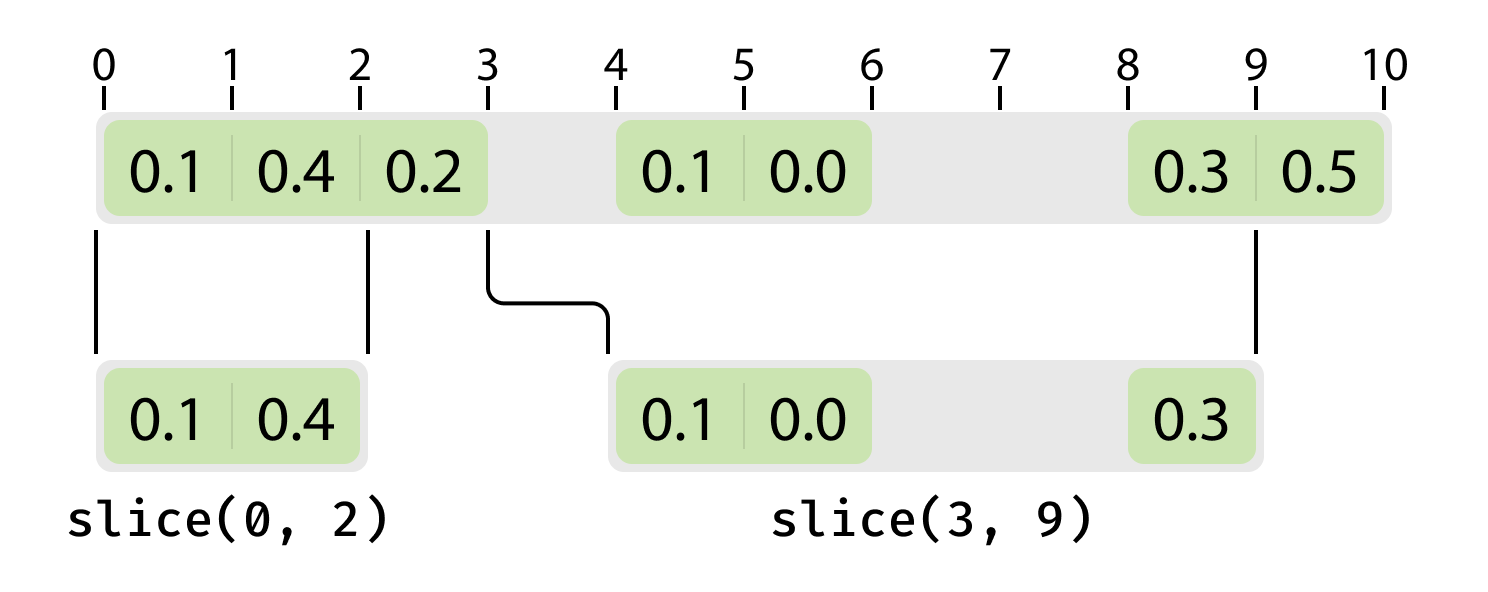
Slicing gappy RegularTimeSeries#
A slice that is entirely within a contiguous section is no longer gappy:
>>> sliced = signal.slice(0.0, 2.0, reset_origin=False)
>>> sliced.timestamps
array([ 0.,  1.])
>>> sliced.is_gappy()
False
A slice that falls entirely within a gap returns an empty series:
>>> empty = signal.slice(6.0, 8.0, reset_origin=False)
>>> empty.timestamps
array([])
>>> empty.values
array([])
Conversion to IrregularTimeSeries#
to_irregular() drops gap-fill samples and returns an
IrregularTimeSeries containing only real observations:
>>> irts = signal.to_irregular()
>>> irts.timestamps
array([0., 1., 2., 4., 5., 8., 9.])
>>> irts.values
array([0.1, 0.4, 0.2, 0.1, 0. , 0.3, 0.5])
>>> irts.domain.start, irts.domain.end
array([0., 4., 8.]), array([3., 6., 10.])
The resulting object’s domain matches the original gappy series’ multi-interval domain, so the gaps remain explicit even after conversion.